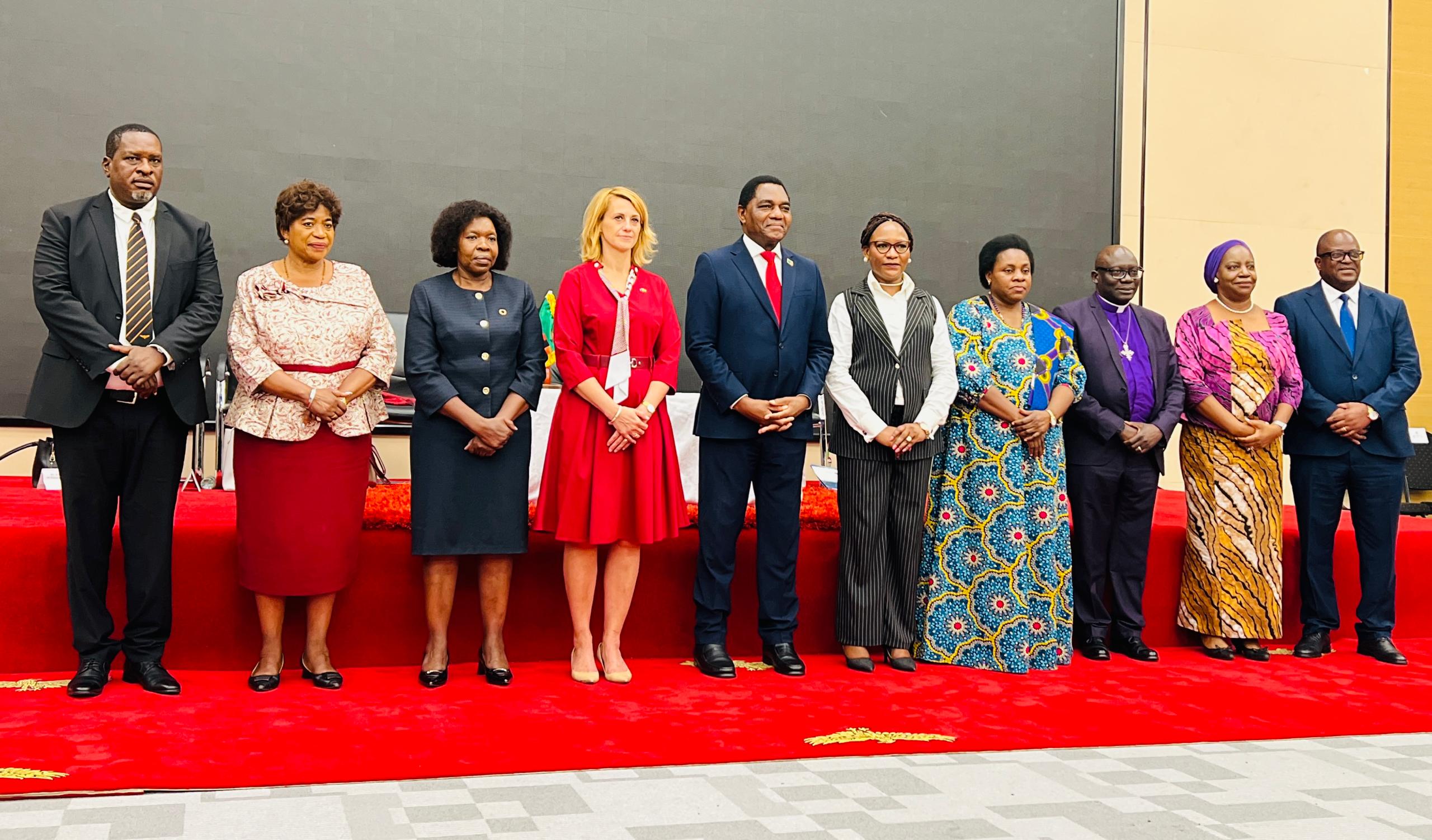
The President of the Republic of Zambia, Mr. Hakainde Hichilema, reaffirmed his government’s commitment to promoting and protecting human rights in the country through practical policies that enhance human dignity, justice and freedom for all, as he urged the United Nations and the international community to do more to actualise the commitments enshrined in the Universal Declaration of Human Rights (UDHR).
Speaking during the International Human Rights Day commemoration held on 10th December, 2025 at Mulungushi International Conference Centre, President Hichilema said that human rights were daily necessities and not privileges, prompting his government to work tirelessly to improve the economy and ensure human rights safeguards.
“Treasury resources are limited, but we should show commitment…That is why our interpretation of this year’s theme (Human Rights: Our Everyday Essentials) is to expand the economy, to grow the economy, so we can create opportunities for jobs, for business… the cycle goes around, enhancing treasury income so we can support free education and the Constituency Development Fund instrument,” the President said.
He said that the government policy of Constituency Development Fund was critical to the enjoyment of human rights, as it was delivering clinics with maternity wings and clean running water, supporting free education through the provision of infrastructure and desks, among other benefits.
In actualising the UDHR, President Hichilema called for universal access to free education and reiterated his call for a fair global financial architecture to help Zambia and other low-income countries grow their economies, which will help them fulfill their human rights commitments.
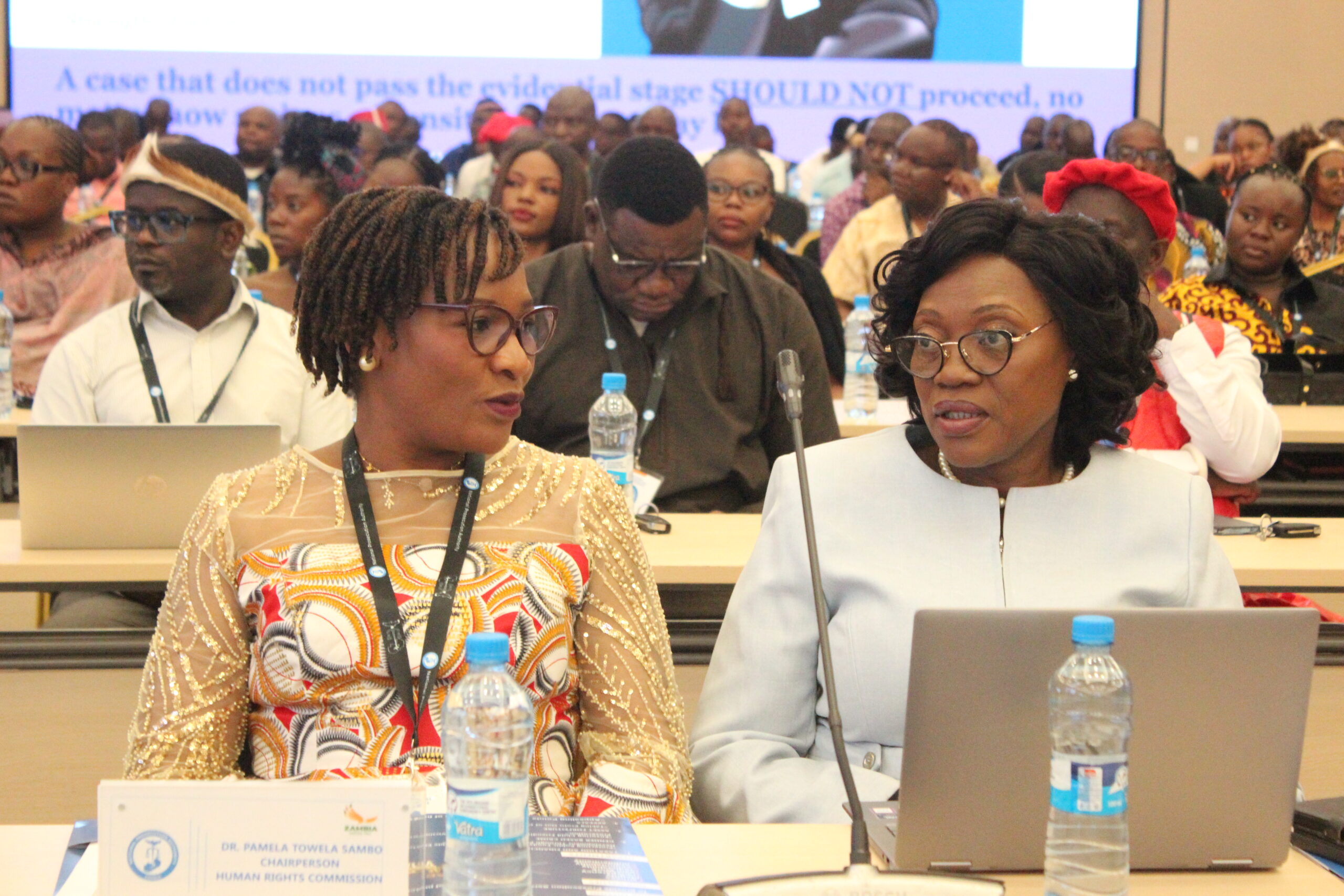
Speaking at the same event, Human Rights Commission of Zambia Chairperson, Dr. Pamela Towela Sambo, acknowledged the repealing and enactment of various pieces of legislation, such as the abolition of death penalty; repeal of the criminal offence of defamation of the President; and the enactment of the Access to Information Act and the Children’s Code Act, as important steps towards strengthening accountability, advancing dignity and enhancing human rights protection in Zambia.
Dr. Sambo, however, noted that further reforms were needed, including repealing the Public Order Act and expanding the Bill of Rights to incorporate economic, social and cultural rights.
She expressed concern over the rise in violations of children’s rights, despite the enactment of the Children’s Code Act and urged key stakeholders, such as the Ministry of Education and the Ministry of Home Affairs and Internal Security, to do more to address the violation and abuse of children’s rights. Among them are the deprivation of liberty of children in conflict with the law; limited use of diversion; delayed disposal of children’s matters; and violence against children in schools, including corporal punishment.
Meanwhile, the United Nations Resident Coordinator, Ms. Beatrice Mutali, commended the government for enacting the Access to Information Act.
Ms. Mutali stated that the implementation of this Act was crucial in promoting transparency and called for the promotion of freedoms of expression and peaceful assembly, as well as the rights to dignity, safety and security, ahead of the 2026 general elections.
“We urge all stakeholders to participate in constructive dialogue, to respect differing perspectives and to uphold Zambia’s regional and international reputation as a stable democracy,” she said.
Furthermore, European Union Ambassador to Zambia and the Common Market for Eastern and Southern Africa, Her Excellency Karolina Stasiak, acknowledged and welcomed Zambia’s growing international role in the global human rights scene.
Ms. Stasiak said that Zambia’s stated goal of seeking a seat on the United Nations Human Rights Council showed the country’s desire to assume leadership in promoting human rights and democracy regionally and internationally.
In her address, Lusaka Province Minister Sheal Mulyata said that human rights were a cornerstone of every civilised society, as they provide assurance to the values of justice, cooperation and respect for human dignity.
Meanwhile Non-Governmental Gender Organisations Coordinating Council (NGOCC) Chairperson, Ms. Beauty Katebe, commended the government for its continued commitment to ensuring that the country was up-to-date with various regional and international human rights and peer review mechanisms, particularly the Universal Periodic Review, and was complying with the reporting requirements on the International Covenant on Civil and Political Rights, the African Charter on Human and Peoples’ Rights, the Maputo Protocol and the Kampala Convention.
Reading the speech on behalf of the NGOCC Chairperson, the Publicity Secretary, Ms. Leah Mitaba, said that “the commitment to these agreements is testament to Zambia’s accountability and transparency in as far as upholding human rights is concerned.”
International Human Rights Day is commemorated globally to celebrate the adoption of the UDHR by the United Nations General Assembly on 10th December, 1948.